Do we know the price of everything and the value of nothing?
Oscar Wilde’s quip, spoken by Lord Darlington in Lady Windermere’s Fan, that a cynic was “a man who knows the price of everything and the value of nothing” is often quoted. In my less optimistic moods (which I hope are few and far between!) I wonder if some of us may be in danger of slipping into a somewhat cynical view when it comes to what we buy and consume and its impact on the natural environment. One which perhaps puts short term economic gain above understanding the longer-term value of our natural habitats and species? A view, perhaps, which considers the destruction of tracts of ancient forest or woodland in the interests of commerce to be an acceptable price to pay without fully appreciating and factoring in the longer term value of the “ecosystem services” associated with tracts of land, mountains, streams, rivers, oceans and the air we breathe? These are often irreplaceable and sometimes hidden services which, collectively, add value to human’s quality of life, health and wellbeing and the long-term health and sustainability of this tiny planet of ours. As a consumer, do I care more about the price of goods I buy than the cost to the planet of getting them to me at that price?
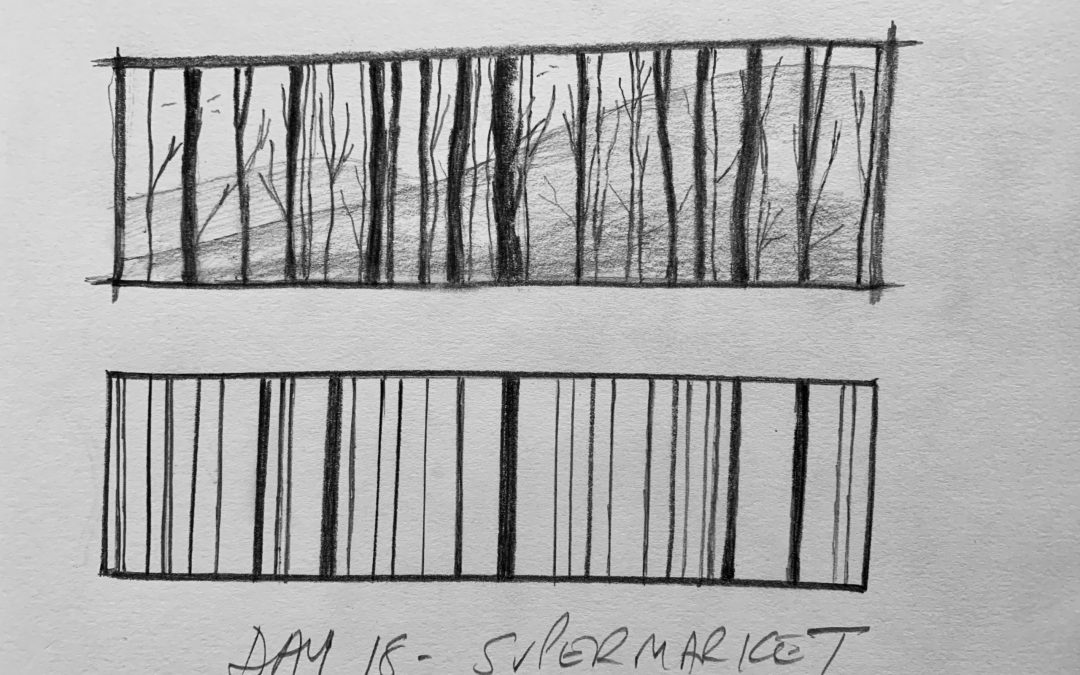
I was prompted to write this article by an unexpected exchange I had recently with a complete stranger living in Australia. She, like me and 5500 other part-time artists, has kicked off 2020 by taking part in a “Sketchbook Challenge”[i] – producing a daily sketch in response to a subject prompt provided by the organiser and sharing this on a Facebook group. One particular prompt was “Supermarkets” and, short of time and inspired by a walk in some local woods, I decided to sketch a line of tree trunks which reminded me of the ubiquitous bar code used by all stores to price up goods. (Perhaps, I thought, ‘bark code” might be more accurate in this context!)
My quick drawing (As seen above) obviously struck a chord with a fellow sketcher from down under who responded with a stark picture of a similar line of trees with the sad difference that hers were standing charred and lifeless as a result of the recent bushfires. She added
“Your “bark code” is a great thought. The tree image brings to mind our post bushfire scenes in Australia. What price are we paying?…. In their distress, Australians have been hugely moved by the care and concern from other countries. And many of us hope it translates into far deeper global action”.

Image of woodland devastated by bushfires in Australia
At the time of writing the bush fires have claimed 28 lives and burned an estimated 100,000 km2 (15.6 million acres) of bush, forest and parks across Australia – equivalent of 40% of the entire UK. According to the Worldwide Fund for Nature (WWF) an estimated 1.25 billion animals have been affected, including 30% of the entire koala population in mid-north coast of New South Wales.
Whilst not new (and, arguably, in proportion, bush fires are a natural and necessary part of the way ecosystems regenerate), the scale, ferocity and duration of the current fires is exceptional. As WWF highlight “these catastrophic megafires are worsening the extinction crisis we are already facing”. Climate change is recognised as a significant factor in all this and yet, collectively, we still seem to be prepared to pay the price for carbon-fuelled goods and services that contribute to global warming without fully realising the damage being done and the value to long term quality of life on our planet that is being stripped out by them.
Sadly, the list is long of other aspects of the natural environment whose value – from our day to day buying choices – we appear not to fully appreciate:
- One million species (about one eight of the total) are at risk of extinction due to the change of use of land and sea, pollution, climate change and over exploitation of resources
- Eight million tonnes of plastic are thrown into our oceans each year – much of which breaks down into toxic microplastic. On average, we each ingest 5 grams of plastic each week (about one credit card’s worth)
- 17% of the Amazonian rainforest – the lungs of our planet – have been destroyed over the past 50 years
- Despite the national commitments made via the 2016 Paris Agreement, carbon emission curbs are not currently enough to prevent global temperatures rising above the 2 degC target level
In his recent speech at the World Economic Forum in Davos, HRH The Prince of Wales highlighted the importance of making the sustainable options the “trusted and attainable options for consumers”. He highlighted that, with consumers controlling an estimated 60 per cent of global GDP, “people around the world have the power to drive the transformation to sustainable markets. Yet, we cannot expect consumers to make sustainable choices if these choices are not clearly laid before them. As consumers increasingly demand sustainable products, they deserve to be told more about product lifecycles, supply chains and production methods. For a transition to take place, being socially and environmentally conscious cannot only be for those who can afford it. If all the true costs are taken into account, being socially and environmentally responsible should be the least expensive option because it leaves the smallest footprint behind. We must communicate better with consumers about the sustainability of the goods, services and investments we offer.”
Being better informed about the long term sustainability impact of the goods and services we buy is a key step in helping us to make sustainable buying decisions. Not only can we know the up front price but we can decide if that price is right considering the value of the resources required to produce or provide these goods and services. Through these decisions we can play our part in this critical decade to protect those resources. Perhaps the time has come for us to “bark code” all our forests, mountains, streams, rivers and oceans?
(This article also appears in February 2020 edition of the Messenger – the monthly publication of the Manchester Law Society)
[i] http://www.magenta-sky.com/online-courses/30-day-sketchbook-challenge/