by Beth Salt | Dec 13, 2023 | COP Hub, LSA Insights
By Caroline May, Co Chair, Legal Sustainability Alliance
“The earth does not belong to us, we belong to the earth.”
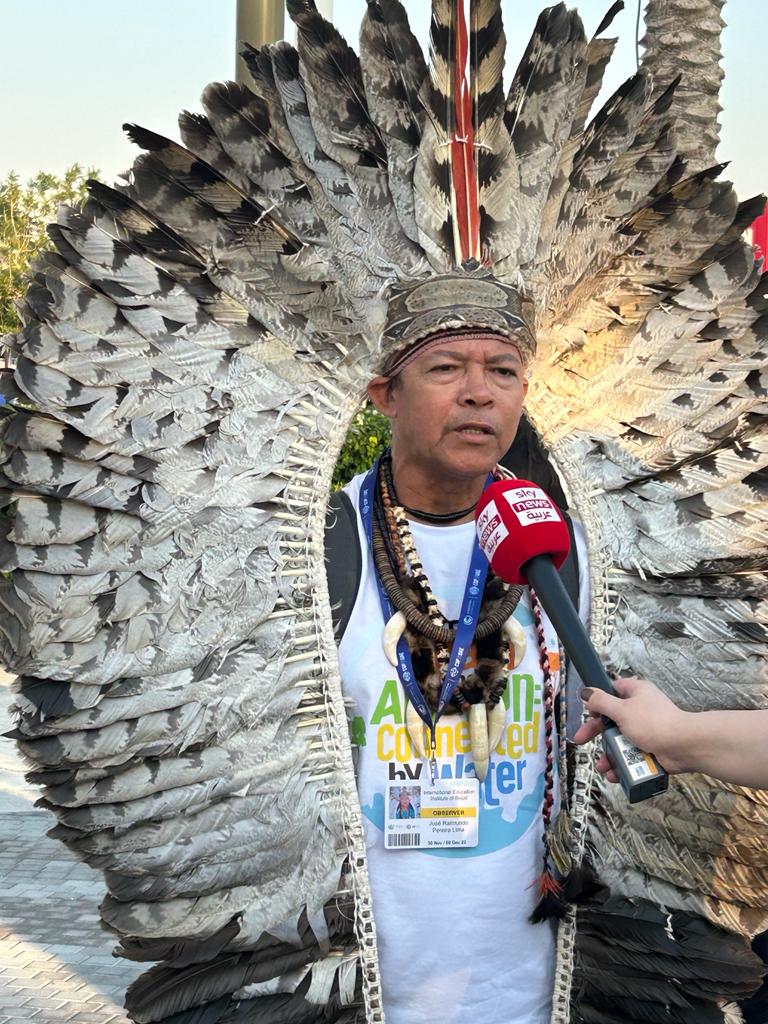
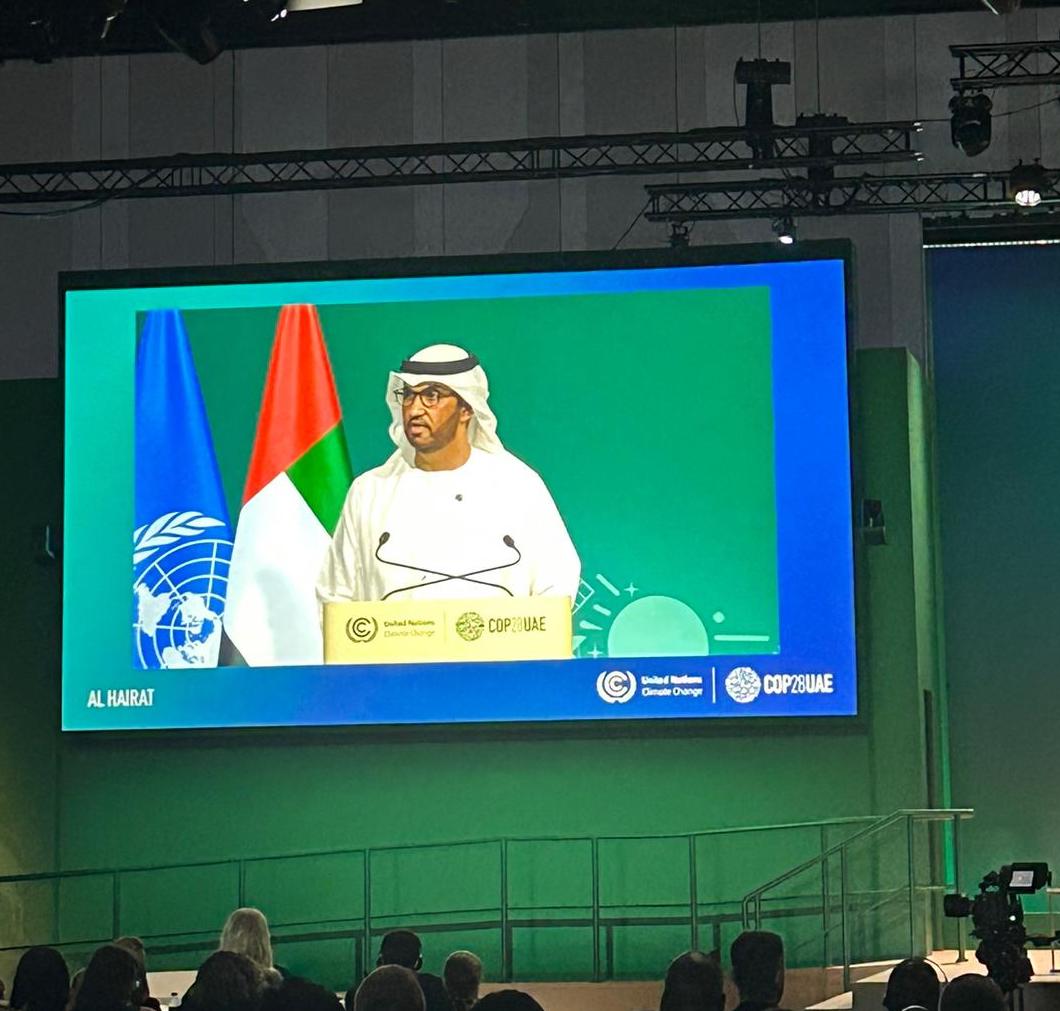
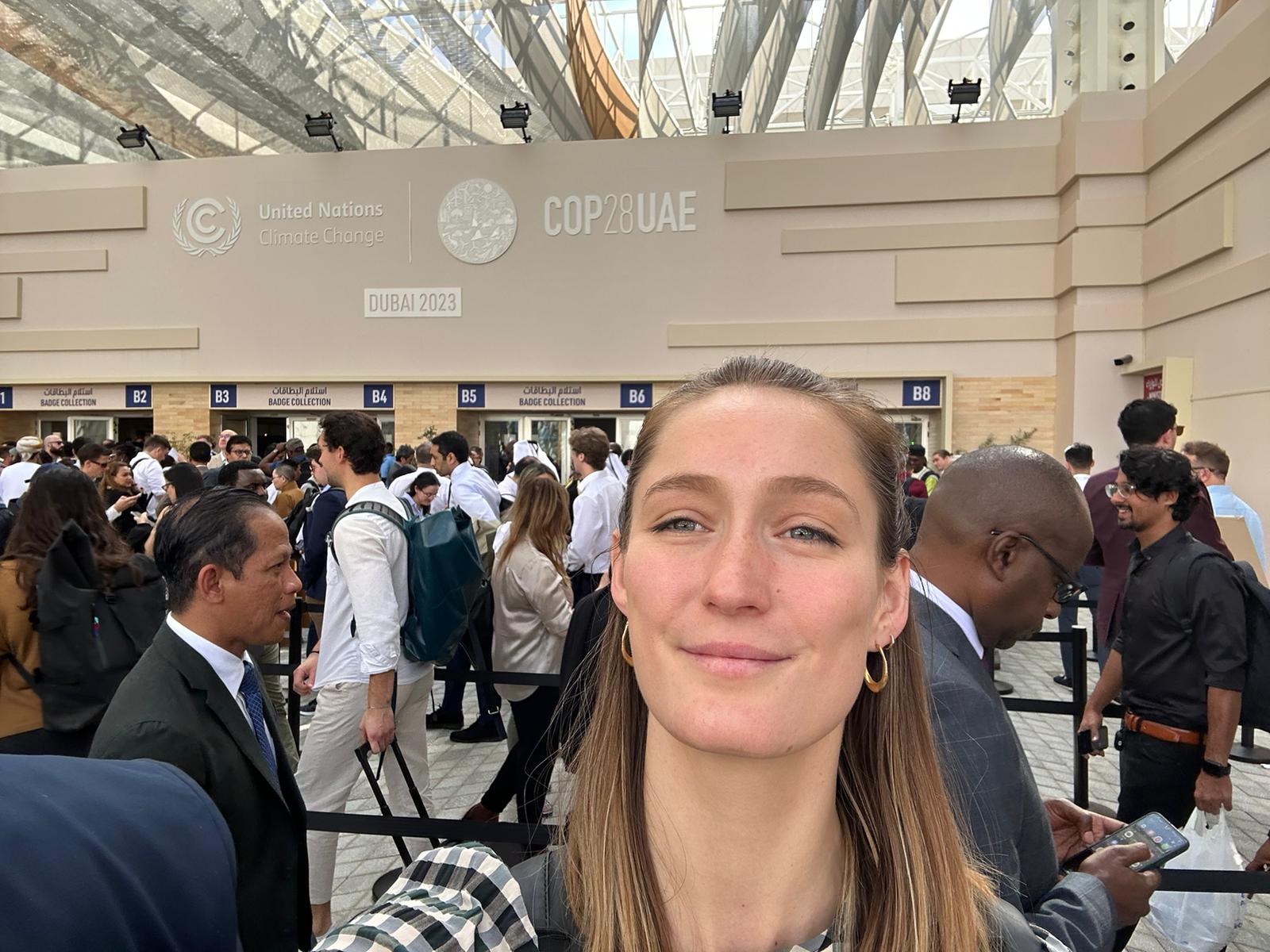
The words of King Charles on opening COP 28 in Dubai last week. I arrived for the opening day amid a crowd of 70,000 people queuing to enter the Blue zone at the vast Expo complex 20 miles south of the City. A bewildering mix of royalty, world leaders, business leaders, NGO’s, Government delegations and representatives of communities most affected by climate change. It would be hard to imagine such an eclectic group gathering for any other reason.
However the climate imperative draws everyone together for diplomatic negotiations, public pledges, innovation and funding launched, and providing a voice to those often forgotten. There is an increasing business presence at these events and that is important. The role of climate finance is essential in driving change. Law has an important role to play providing frameworks in which climate conscious actions are incentivised, rewarded and as needed penalised.
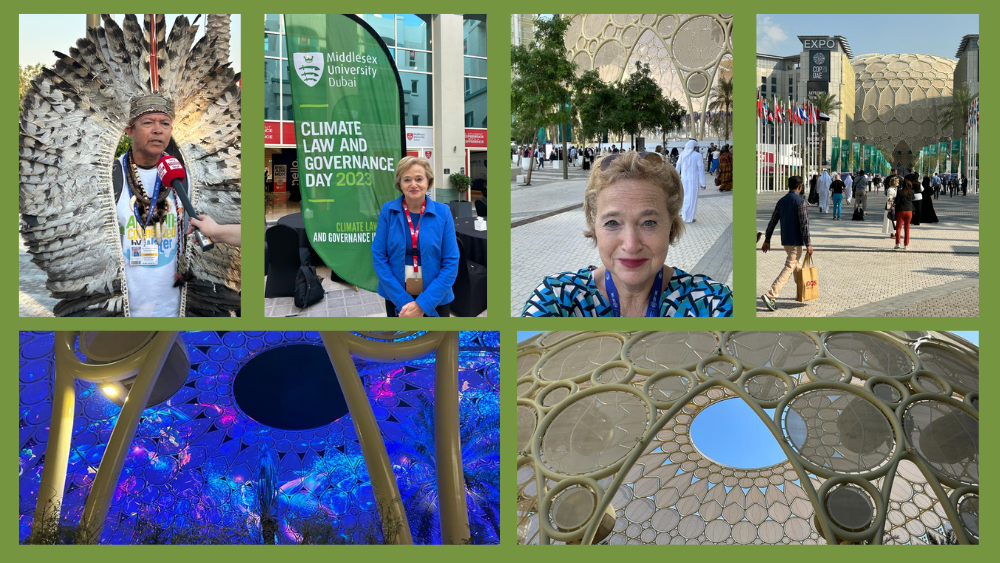
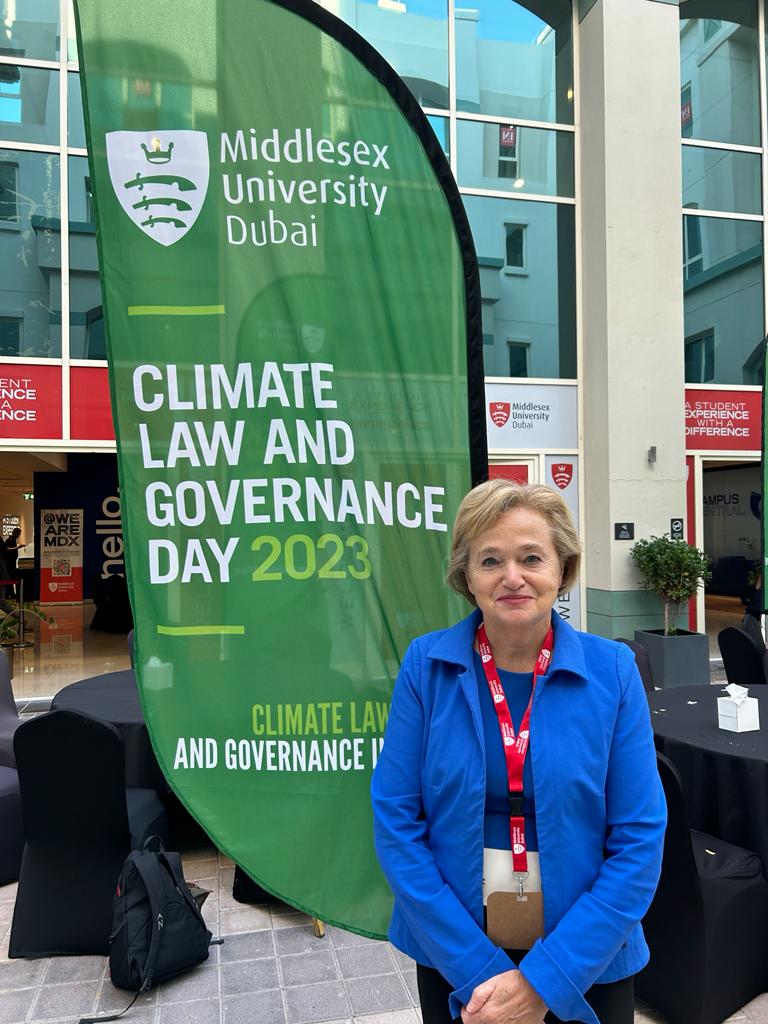
I spoke at the Climate Law and Governance day hosted by the Universities of Dubai, Cambridge and Middlesex at their sparking campus. My subject was the role of EU law and the profession generally in driving change as the guest of EBRD. Topics covered during a whole day of legal presentations included climate finance and trade, carbon taxes and carbon credits and greenwashing risks. It was good to bump into so many LSA members!
I also spoke on a panel at the ICUN pavilion about the Law Society guidance on The Impact of Climate Change on Solicitors in England & Wales. The consensus of our panel of international Bar Associations including the IBA, ABA and Brazilian Bar was that the official UNFCC timetable for COP should include a Law Day and we will lobby hard for that to be on the agenda for COP 29.
If you have been following the news from COP you will have seen the major pledges. I set out in summary the key ones below.
- Firstly, the main issue which delayed agreement on the COP28 text is language on fossil fuels. The final agreement calls for the “phase-down of unabated coal power” and the transition “away from fossil fuels in energy systems, in a just, orderly and equitable manner… so to achieve net zero by 2050 in keeping with the science.” It’s not what most developed countries (and climate activists) had been calling for, but is still a major achievement. The final text is yet to be officially released.
- The loss and damage fund, first agreed at COP27, was launched this year with a series of major pledges. The biggest funders thus far are Italy and France, each donating $108.9 million, and the UAE and Germany, both promising $100 million. It will be hosted by the World Bank, at least for its first four years. A complete list of countries that have donated to the fund can be found here.
- 130 countries signed onto a pledge to triple the world’s renewable energy capacity and double the global average annual rate of energy efficiency improvements every year until 2030. Whilst the US and EU have both signed, India and China are yet to do so. For more information on why this is such a significant achievement, especially in relation to the energy efficiency element, see the article from Energy Monitor linked here.
- 52 oil and gas companies, representing 40% of global oil production, have joined the Oil and Gas Decarbonization Charter. The group, which includes Saudi Aramco and ExxonMobil are promising to make their operations net-zero by 2050 and to eliminate routine flaring by 2030. More info here.
- More than 20 countries, including the US, UK, Australia and Japan, have pledged to triple their nuclear energy capacity by 2050, by building new plants and prolonging the lives of existing ones. This will be tricky, not only requiring a major scale-up of the sector in many of the signatory countries but also addressing the fact that Russia is currently the only significant producer of one of the most crucial forms of uranium used in nuclear reactors, amongst other difficulties explained in greater detail here.
- 10 countries, including the US, joined the Powering Past Coal Alliance (PPCA), which requires signatories to phase out unabated coal power generation and set a moratorium on new coal power stations. The PPCA declaration can be read in full here.
- 158 countries signed the UAE Declaration on Sustainable Agriculture, Resilient Food Systems and Climate Action, which calls on governments to scale up the adaptation and resilience of food producers and promote food security and nutrition. Concerns over the stability of global food systems has risen to the foreground in recent years so this decision is a notable success. The declaration can be read in full here.
- The Green Climate Fund (GCF) received additional pledges, making this round of replenishment funding its most successful yet. The largest donation came from the US ($3 billion) with Australia and Italy also donating substantial amounts. The full list of new GCF pledges announced at COP can be found here.
- Several organisations took the opportunity to publish landmark studies or reports, including the Global Tipping Points Report from the Global Systems Institute. This argues that five major tipping points are already at risk of being crossed and three more are threatened in the 2030s. The full report can be read here.
- In relation to methane emissions, this year several more countries joined the Global Methane Pledge which aims to reduce global methane emissions by 30 percent by 2030 (against 2020 levels). New signatories include Turkmenistan and Kazakhstan, two of the world’s largest methane emitters. Furthermore, more than $1 billion in funding for the Methane Finance Sprint was announced at COP28, to fund physical infrastructure and policy action. When first set-up by Biden in April 2023, his stated goal was for the fund to reach $200 million.
As I leave the sunshine of Dubai intense negotiations continue regarding the terminology of ‘phase down’ or ‘phase out’ of fossil fuels and Article 6 re carbon credit mechanisms. Biodiversity credits were also high on the agenda this year but it’s clear there is still a long way to go. This area in particular offers hope to developing economies rich in natural resources but poor in financial ones.
More to come in this space.
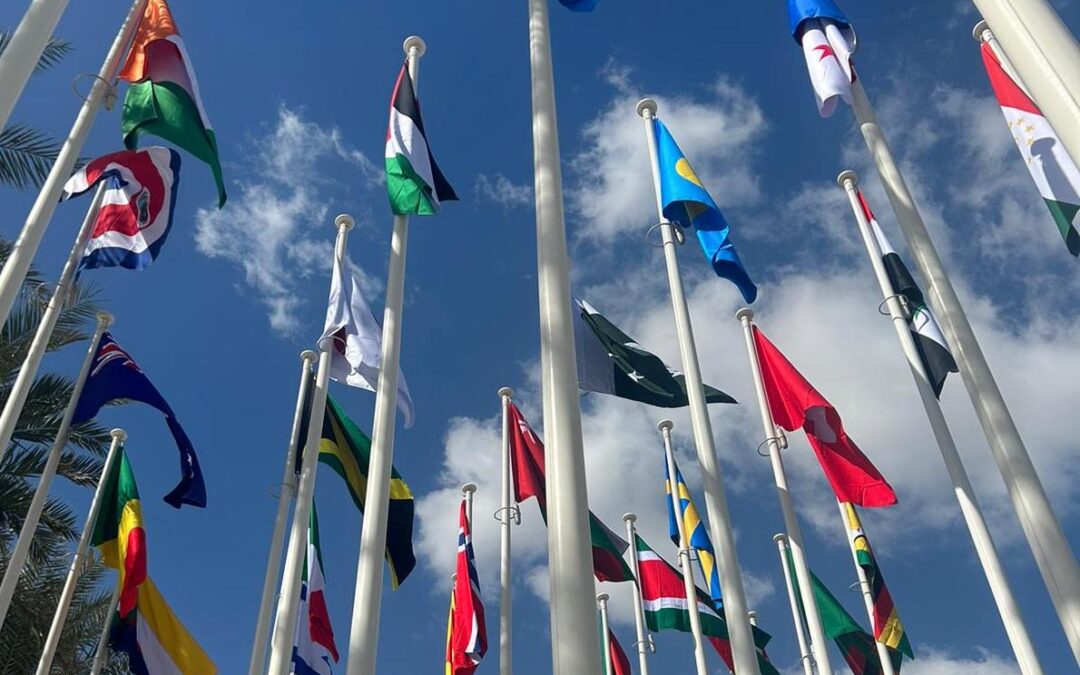
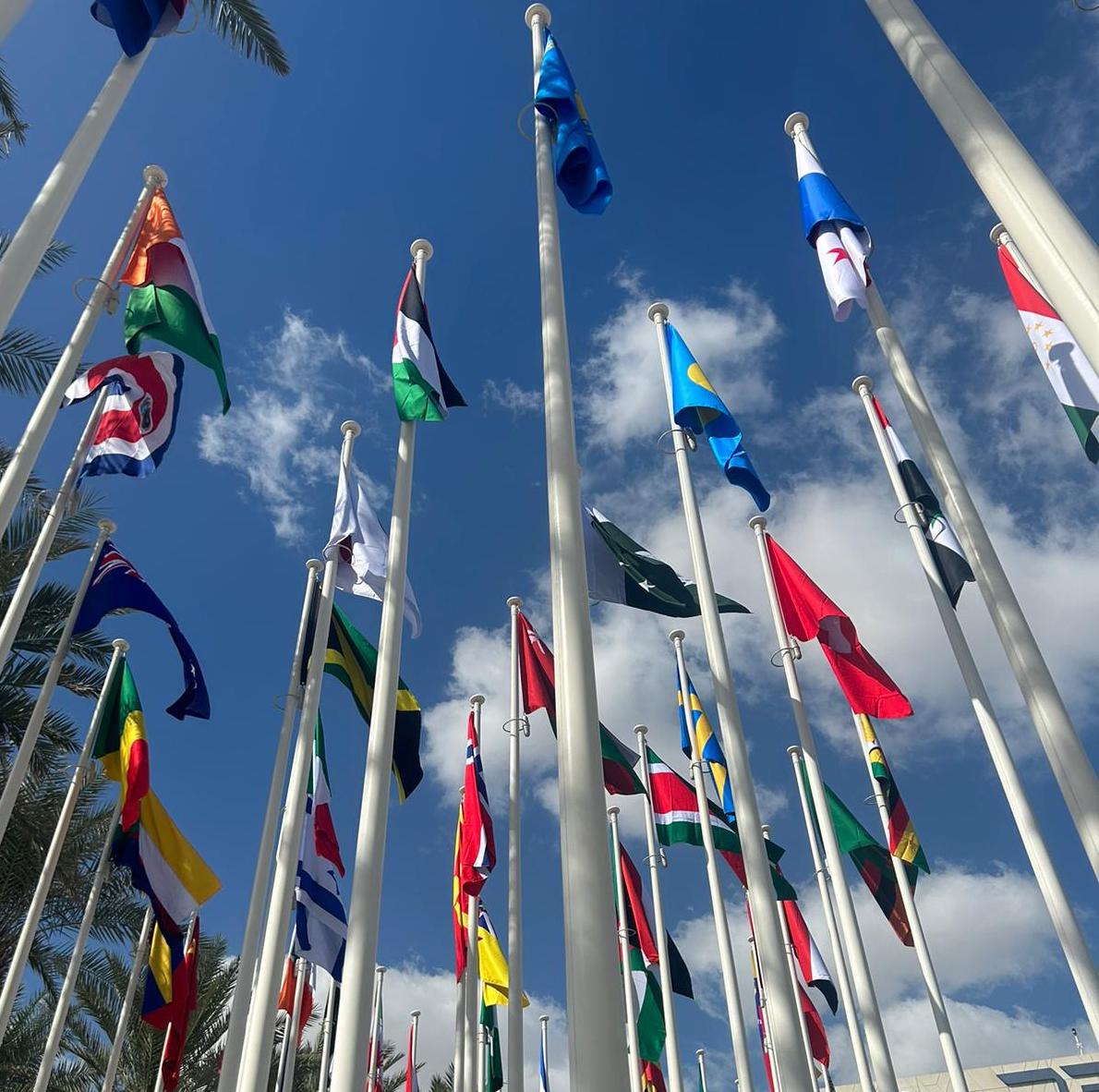
In the meantime I leave you with some pictures of the sights and sounds of COP 28. A mad, diverse cornucopia of mankind but all united to try to align the earth globally to net zero. A noble if complex and challenging cause, but one which has an undeniable imperative for all of us. Until COP 29 …..





by Beth Salt | Dec 1, 2023 | COP Hub, LSA Insights
We are delighted that Sarah Hill-Smith, associate at Clyde & Co, has offered to share her insights from the Blue Zone at COP28 in Dubai to give us a flavour of the atmosphere and progress. Sarah is working pro bono with NGO Legal Response International.
The international negotiations under the United Nations Framework Convention on Climate Change (UNFCCC) are known as the Conferences of Parties (COPs).
 COPs are amongst the most complex multilateral law and policy making processes in existence and LRI seeks to create a more level playing field by offering free legal advice and support to climate vulnerable and poorer nations during climate negotiations.
Wealthy developed nations send larger delegations of hundreds of negotiators who are experts on specific agenda items, meaning that their interests are very well represented across the negotiations. Often, poorer and developing countries (which are typically those most vulnerable to the impacts of climate change) may not be able to afford this presence, and so send a smaller group of negotiators who cannot physically be in every single room, meaning their interests are less represented. As such, like-minded states will often get together and strengthen their negotiating position by forming negotiating blocs with and an aligned view, adding weight to their negotiating position. Examples include the Alliance of Small Island States (AOSIS), G77+ China and the African Group.
LRI, an official observer organisation to the UNFCCC, works with delegates from individual countries as well as the wider negotiating blocs. Whilst Sarah can’t take part in the negotiations on behalf of these states, she can be in the room as an official observer. She might find herself helping to research or interpret points of climate law, policy, diplomacy or procedure for delegates. She might be helping to unpick interpretations of draft text or dealing with ad hoc queries from delegates, such as looking into the constitution of one of the bodies under the UNFCCC and advising on whether an appointment to that body was legal, which happens to be what occupied her on Day 1.
 Working with a team of remote volunteer researchers, LRI also have capability to like help review and draft policy or review policy wordings, and when COP is not running, the organisation helps delegations and countries with capacity building.
After a busy Day 1 at the conference, we had a quick debrief with Sarah, notes below.
We would recommend you also follow Sarah on LinkedIn, where she is posting fascinating updates, which we will also be sharing on the LSA’s page.
You were at COP26 – does this COP seem different?
The scale of the venue and the wider conference is enormous. The venue is swanky and impressive – like most things in Dubai! There are also a few more lawyers on the ground than there were at COP26, which is the last conference I went to with LRI in 2021. The Net Zero Lawyers Alliance is here, and we have been we’ve been having briefing calls with some of the NZLA to align on messaging, which is positive. There are also more events focussed on the role of lawyers as agents and facilitators in driving the energy transition.
 Are you feeling hopeful after Day 1?
There has been a real success story with the decision being taken on day 1 to operationalise the Loss and Damage fund. This is hugely important, particularly for developing countries, but there are some residual doubts about the decision, for example about the fact that the fund will be housed in the World Bank, which is seen by many developing countries as a US-based institution, which may be skewed towards US geopolitical interests. There were also calls for the Fund to operate in alignment with human rights and inclusivity.
Huge thanks to Sarah for talking to us and allowing us to use her photos.
by Beth Salt | Nov 15, 2023 | LSA Insights, Members News
Sustainability, social justice, creating meaningful change – how do you accelerate progress within your firm on an international, national, business and individual level? How do you unify the strands of these vital agendas to encourage colleagues to break down silos and increase collaboration? Law firm Pinsent Masons found the answer lay with the United Nations Sustainable Development Goals (aka SDGs – sometimes also known as the ‘Global Goals’).
We spoke to Mike Harvey, Head of Responsible Business and Sharon Smith, Head of Learning & Knowledge for Climate & Sustainability at Pinsent Masons about how they harnessed the SDGs to inspire colleagues and clients to engage with their responsible business agenda. LSA member firm Pinsent Masons is a multinational law firm which specialises in the energy, infrastructure, financial services, real estate and technology, science & industry sectors.
Having signed up to the UN Global Compact, both Mike Harvey and Sharon Smith wanted to accelerate progress.
“We were both passionate about the SDGs and felt we should be doing more. The initial step was to raise awareness about SDGs – what we do as a firm, what our clients are doing and what we do as individuals.”
Sharon
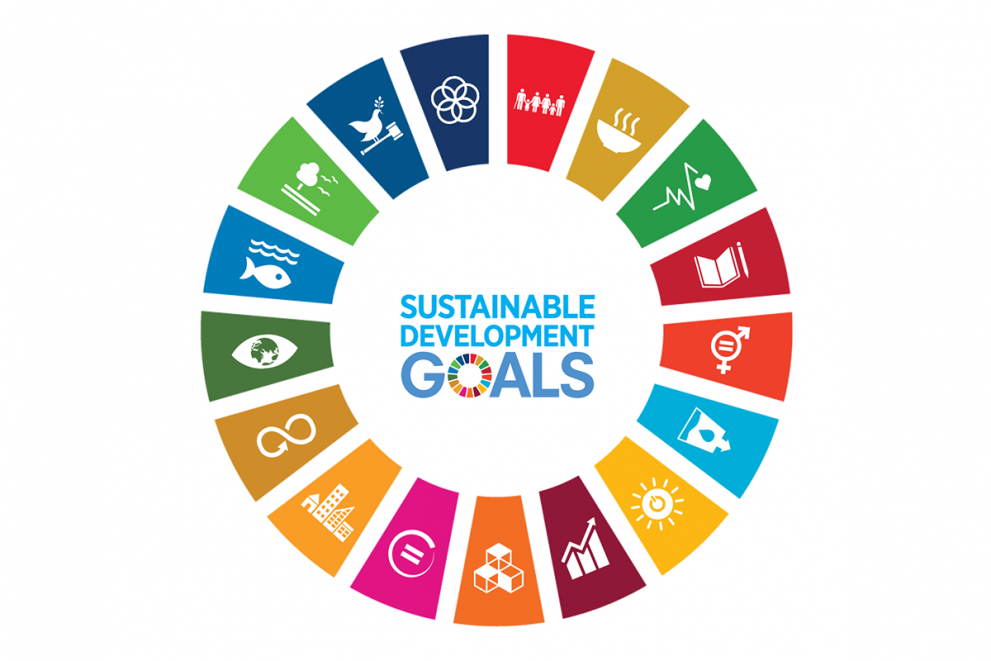
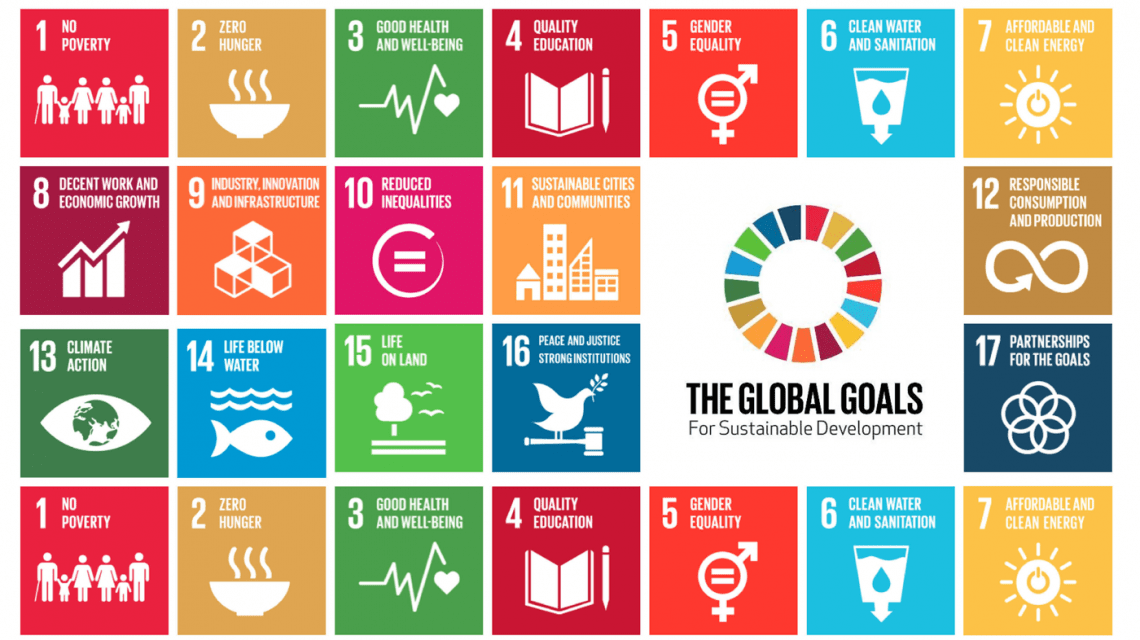
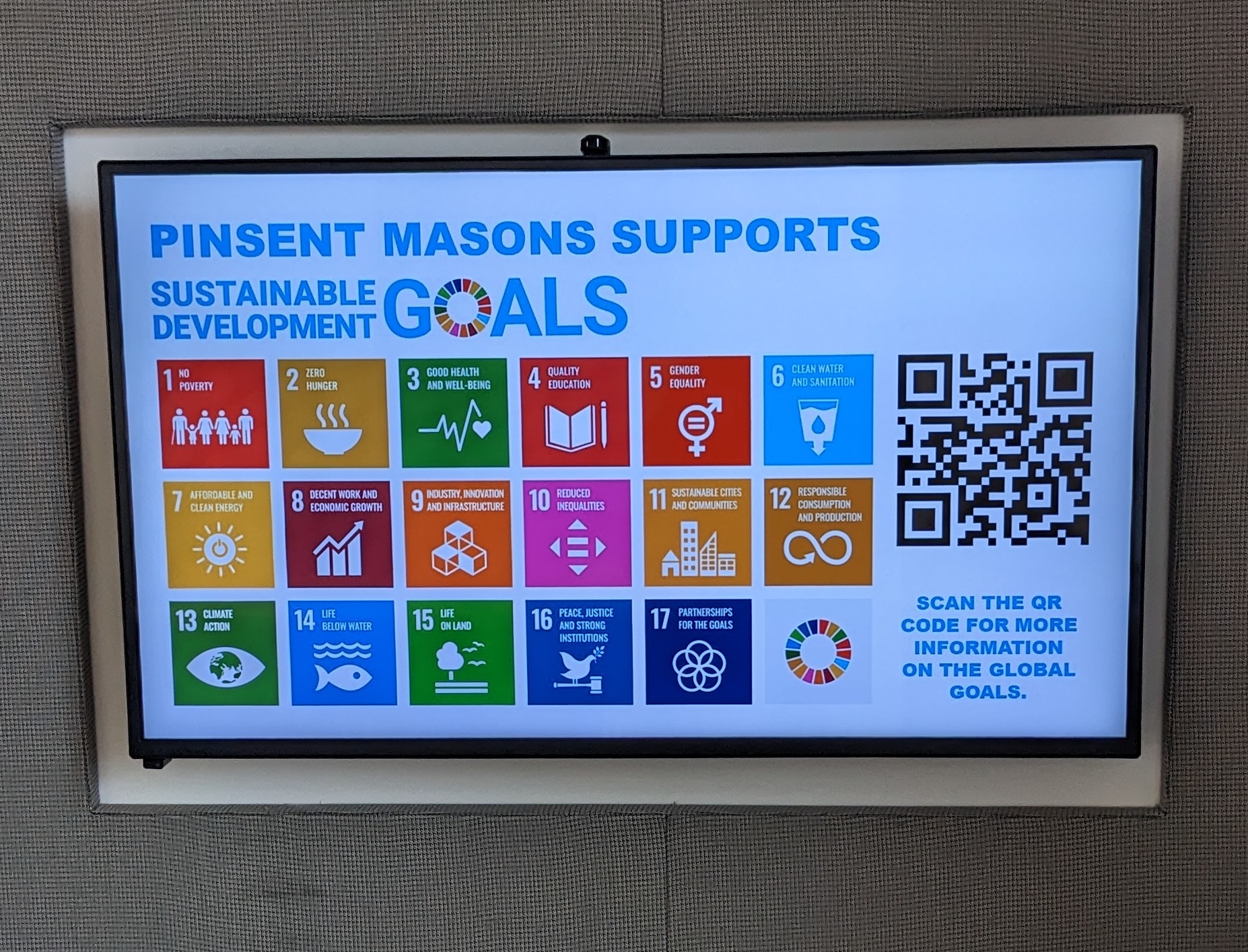
The Sustainable Development Goals are 17 interlinked goals designed to serve as a “shared blueprint for peace and prosperity for people and the planet, now and into the future.” They are ambitious and radical. They act as a comprehensive pathway and were the first of their kind to achieve global consensus, a magnificent example of negotiation and perseverance, a multi-stakeholder engagement process involving governments, businesses, intergovernmental organisations and civil society. It helps that they come with recognisable visuals which are engaging and easy to use. In fact the simple graphics are quickly becoming iconic.
“The SDGs are a useful framework to talk to our clients and suppliers – a common language that we all work to and a tool to build deeper relationships.”
Mike
“With things that are going on in the world it can feel like ‘it’s out of my control’. The SDGs can help people feel empowered. They can help people find purpose and meaning in what they are doing. It can help to build morale and a sense of community.”
Sharon
Each of the SDGs represents a complex but important area. The team ran an internal survey asking, amongst other things, what is your awareness of the SDGs? Awareness was low, but they sensed there was an appetite to find out more. Mike and Sharon decided that the key to building an enduring and resilient campaign was to spend a month on each SDG, but not to be limited by this schedule. If one SDG remained relevant for longer, because of an international event or diary date, then the schedule would facilitate that.
Certain SDGs seemed to fit certain times of the year – for example SDG 2 – Zero Hunger was scheduled to coincide with Christmas and incorporated the work that they were already doing with food banks and schools. SDG 14 – Life Below Water, fitted in with Plastic Free July and SDG 13 – Climate Action ran alongside the UNFCCC COP.
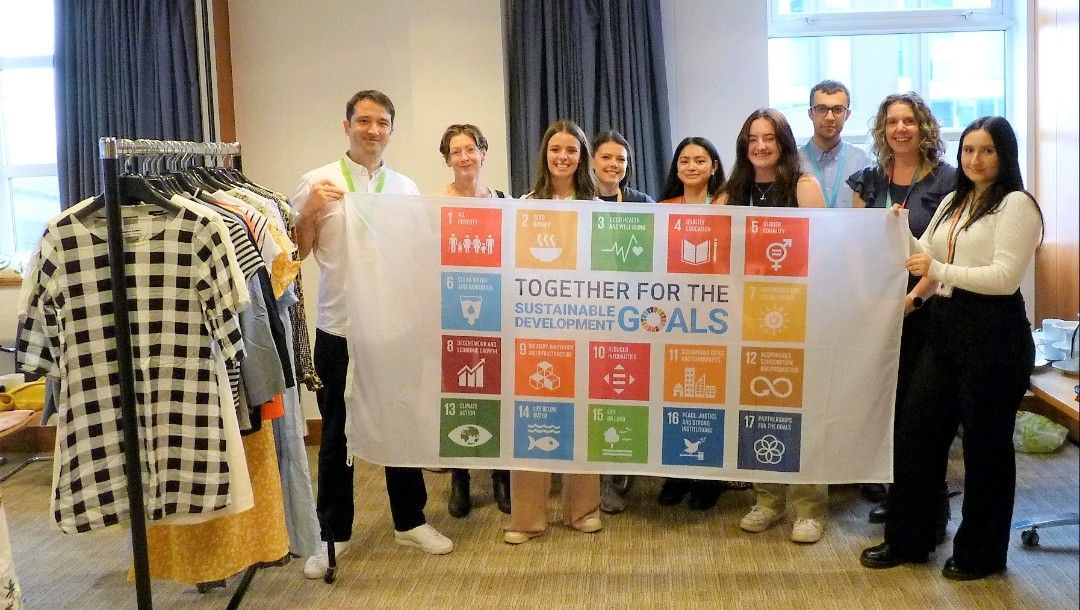
An SDG Working Group including Mike, Sharon and members from the firm’s Spark Board and Responsible Business team was set up to work on campaign actions, and SDG Champions, including senior partners and managers at the firm, volunteered to champion specific SDGs. They used MS Viva Engage to share internal communications, including YouTube video explainers to engage with colleagues.
The team set KPIs to measure impact, the key one being – would individuals in the firm start talking about the SDGs independently of the campaign? Monitoring social media and internal comms they soon realised this was happening. That was a moment of celebration! The campaign, which both admit was a learning process, had evolved into a grassroots movement.
“We decided it would be a slow burn – a longer process. We wanted to combine the SDG campaign with other initiatives so they all joined up. We didn’t want this to be just another campaign.”
Mike
The campaign kicked off by using the SDGs as an umbrella to unite responsible business activities and raise awareness, but the team soon found that the framework was highlighting areas in which they could do more, which in turn inspired them to engage internationally and find commonalities so they could take action to plug those gaps.
Highlights of the campaign saw the London office being lit up in the colours of the SDGs and SDG icons, (including on flags, pin badges and visual media) being placed around the firm, generating conversations and galvanising action. The campaign engendered a feeling throughout the firm that they were moving forward as one.
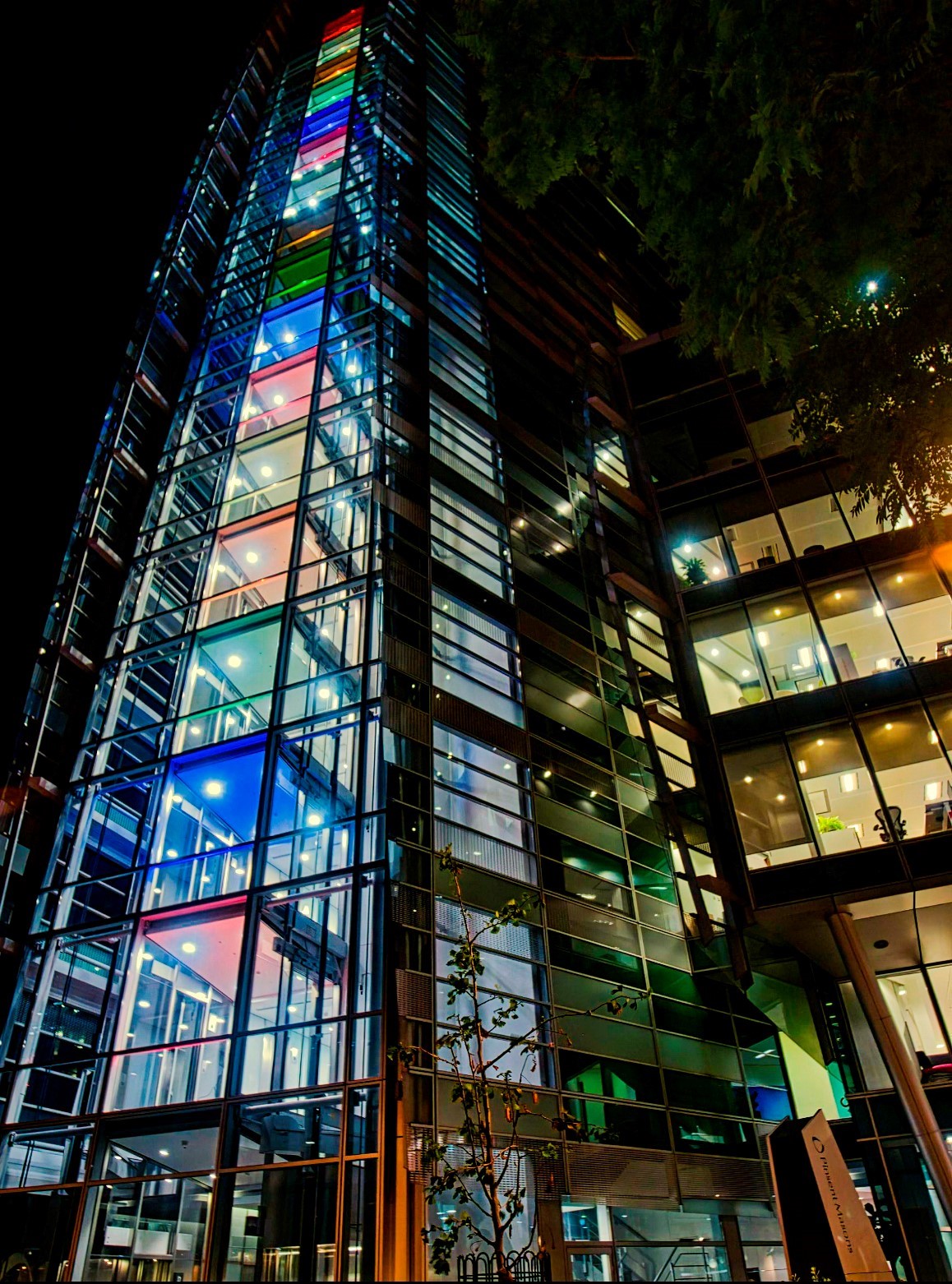
Crown Place lit up in the colours of the SDGs
We asked Sharon and Mike what advice they would offer to a firm considering using the SDGs to amplify and consolidate their ESG activity.
“Just start! It can feel so big and overwhelming. The best thing to do is just start.”
Mike
“I agree with Mike. Try and find which SDGs resonate with people in your firm and just start!”
Sharon
The campaign has been such a success that Pinsent Masons are planning to keep it rolling, revisiting a new SDG each month, given the constantly changing nature of the ESG landscape and the appetite within the firm to evolve with it.
If you have a sustainability success story to share with us please email comms@legalsustainabilityalliance.com.

by Beth Salt | Nov 14, 2023 | COP Hub, LSA Insights
 Reducing energy consumption reduces your carbon footprint, lowers operational costs and has a positive impact on the environment. Because the greenest energy is the energy that we don’t use, the LSA already works hard to support firms to reduce their scope 2 emissions through implementing energy efficiency measures and educating the workforce. However, we need to keep the lights on and offices warm – so when we do use energy, we want to ensure that it is the greenest energy available to us with the lowest environmental impact. That is where the Legal Renewables Initiative comes in.
We are delighted to be working with Good Energy to capitalise on their expertise in this area. As the only UK based 100% non nuclear renewable energy company we believe they can offer additional insight and support to law firms when it comes to thinking about a switch to a green tariff. They have been placed at the top of Which’s Eco provider table for three years running.
“The availability of renewable power is surging, driven by the global energy crisis, declining costs and policy momentum. By embracing renewable energy, legal firms in the UK not only demonstrate a commitment to environmental sustainability but also pave the way for a greener future. Leading the charge in sustainable practices, they set a powerful example for the corporate sector, showcasing how businesses can be both ethical and efficient, ultimately contributing to a cleaner, more sustainable society.”
Tom Parsons, Director of Sales and Origination, Good Energy
The LRI is designed encourage and inform LSA members as they commit to switching to 100% renewable energy by 2025. However, switching to renewable energy is not always as straightforward as contacting your supplier and asking for a green tariff. Many energy suppliers claim that their energy is 100% renewable, but in fact they buy REGOS (Renewable Energy Guarantees of Origin) from the open market without buying the electricity they relate to. Good Energy run differently, matching 100% of the electricity your business uses over a year with power bought directly from their community of over 1,700 independent renewable generators across Britain. See this blog Not All Green Tariffs Are Created Equal for more information.

Not all green tariffs are what they seem
We want to help LSA member firms avoid greenwashing. So, as mentioned, while all green tariffs are a step in the right direction, some are definitely greener than others. Here are some questions that you can ask of your supplier to help you understand if the tariff you are on is truly 100% renewable:
- Ask them how much of their renewable electricity comes from power purchase agreements they hold directly with renewable generators
- Does your renewables spend result in the creation of new renewables?
- Where are your generators based, how local are they to my organisation?
- Does the offsetting scheme for your green gas help to increase the global supply of green gas, or does it involve something unrelated, such as planting trees?
Sometimes all that stands between you and the tariff you want will be understanding the language that your energy supplier uses. Good Energy have created this glossary to help law firms decipher the language of green energy.
Once switched to a renewable source of energy, the next step is to reduce consumption. Throughout the winter the LRI will be offering content to help firms inform and inspire colleagues to save energy.
by Beth Salt | Nov 6, 2023 | LSA Insights
By Jenni Ramos, Lawyer – Corporate/Finance and Biodiversity, Commonwealth Climate and Law Initiative.
In mid-October the Commonwealth Climate Law Initiative (CCLI) delivered a workshop with the Legal Sustainability Alliance (LSA) on biodiversity risk for companies and organisations. This was the first part of a two-part series, the second, on the 15th November, will cover biodiversity risk in legal advice.
The workshop was a real eye-opener for me in demonstrating that the link between biodiversity loss and our work as lawyers is as real and deep as our impact on the climate crisis. Our opportunities to influence and bring about change through our work with clients is just as great. We’ve known for ages that the two are interlinked but the workshop helps to show that we can and must broaden our ambition away from a sole focus on carbon reduction and apply the same principles and approach that law firms are developing to the challenge of biodiversity loss.
David Berry, Partner & General Counsel, Charles Russell Speechlys LLP
Both workshops feature key messages from the CCLI’s December 2022 report ‘Biodiversity Risk: Legal Implications for Companies and their Directors’ (summarised in this short update).
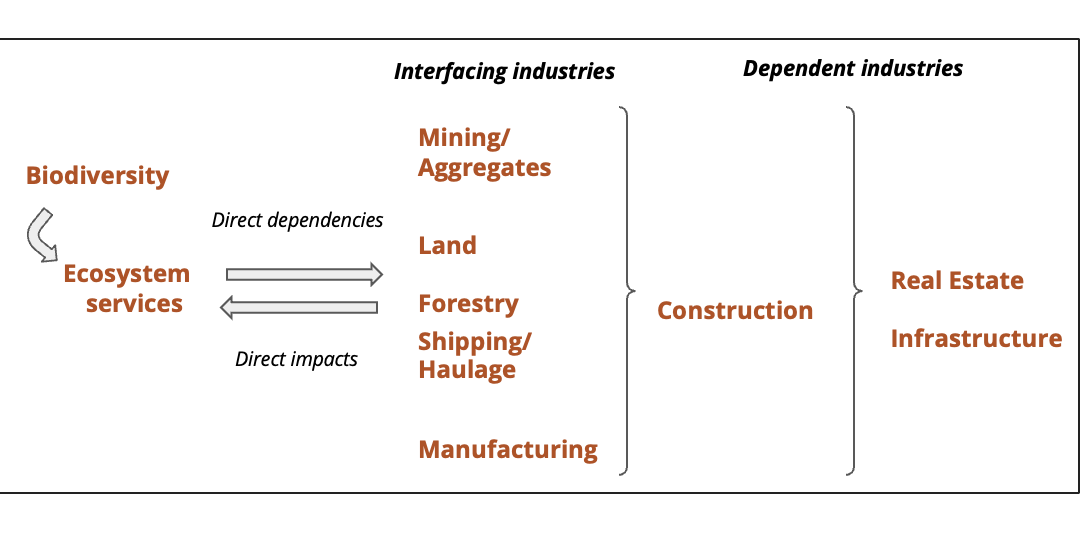
Biodiversity (the variability among living organisms) is a characteristic of nature that underpins the resilience of ecosystems, which provide services to business and society, known as ‘ecosystem services’. Ecosystem services can be provisioning services (e.g. crops, wood or water), regulating and maintenance services (e.g. water flow regulation or pollination) or cultural services (e.g. recreation).
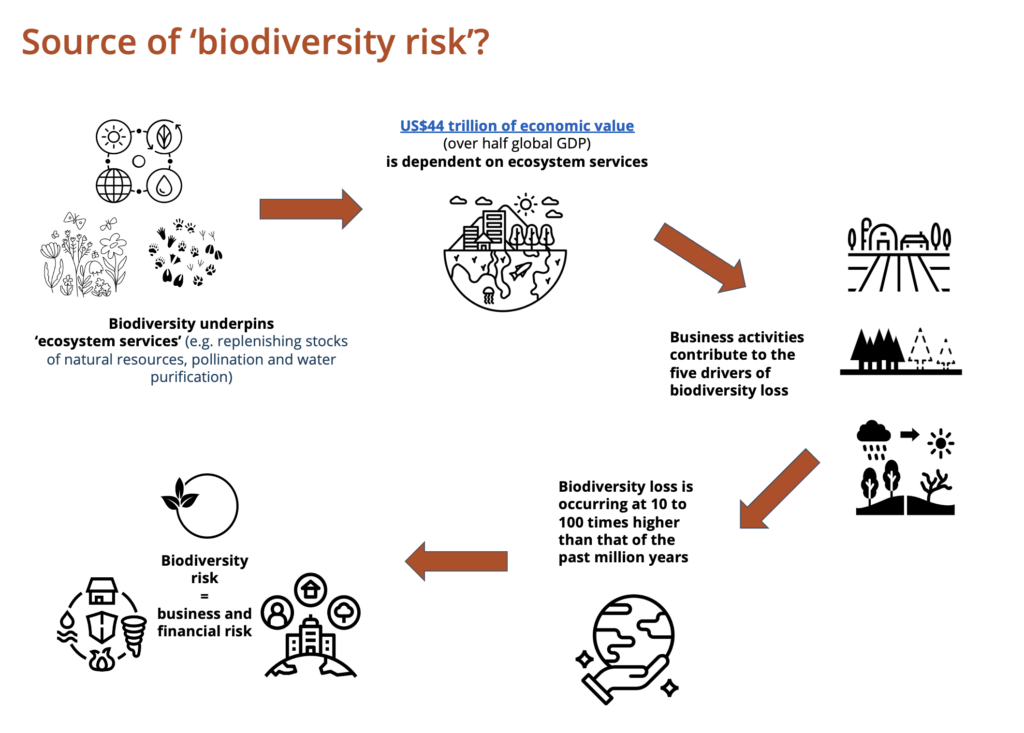
All of global GDP is somewhat dependent on nature, and for over half the economy this dependence is moderate to high. This dependence is often hidden in complex value chains spanning the globe. There is international consensus on the financial materiality of biodiversity risk, ranked by the World Economic Forum as the fourth most severe risk in the next 10 years and a facet of existing risk categories, manifesting as both physical and transition risks. Biodiversity-related business opportunities (e.g. value chain resilience, identifying new products/services, responding to changing consumer and employee preferences, increased investor/lender confidence or access to new capital) may not be discovered without considering how each business interacts with biodiversity.
An example of the biodiversity risk and life cycle of the construction trade:
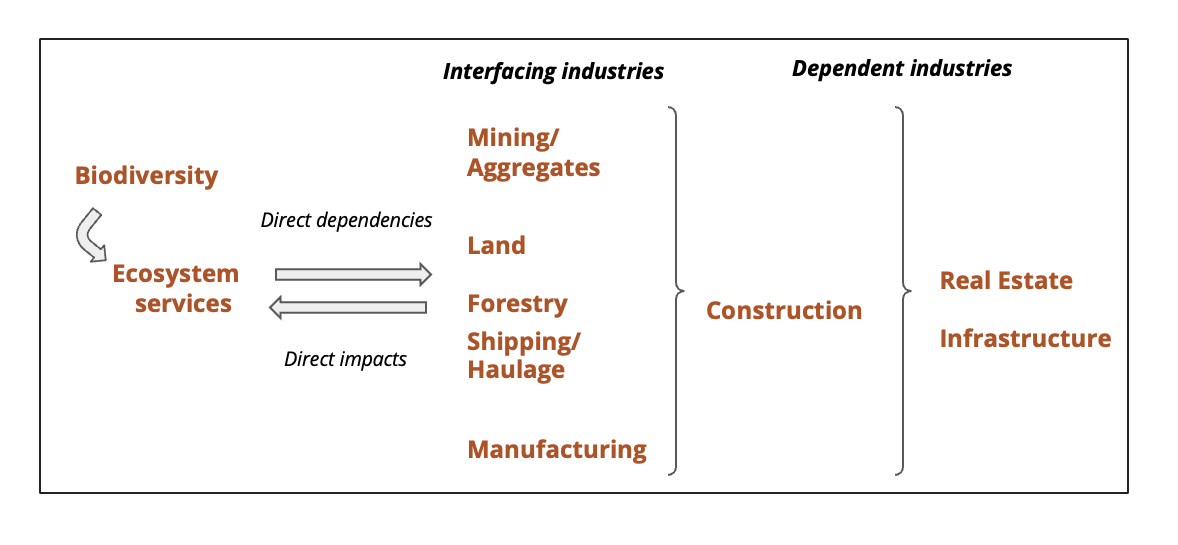
Biodiversity risks and opportunities arise through a company’s impacts and dependencies on ecosystems. Directors’ duties to promote the success of the company and to exercise reasonable care and diligence may require oversight of material biodiversity related risks, including in the context of disclosure and financial reports. Last week, Australian national news and the FT’s Moral Money featured an independent legal opinion by Sebastian Hartford-Davis and Zoe Bush which concluded that nature-related risks to Australian companies should be regarded as foreseeable now. The opinion recommended that directors of Australian companies need to identify their company’s dependencies and impacts on nature and consider potential risks these pose to the company. Similar conclusions could be drawn in other common law jurisdictions such as the UK.
Participants at last month’s workshop explored what this means in practice for law firms and clients as organisations that have impacts and dependencies on biodiversity. We explored the value chain of the legal industry and a hypothetical client, analysing where each organisation might indirectly be dependent and impact upon biodiversity. We discovered that the legal sector is indirectly dependent on ecosystem services through its office buildings (through embedded impacts of its construction and ongoing use), the utilities, paper, furniture, textiles and information technology hardware used when delivering its services, food served to clients, work related travel (both the energy used to travel and vehicle components) and the operation of software and storage of electronic information. Through all these value chain connections the legal sector also impacts on biodiversity and plays a role in ecosystem degradation. This is even without the legal sector’s potential ‘advised nature impacts’ (similar to advised emissions – see the Legal Charter 1.5’s Principle 2, The Law Society’s climate change guidance and an Uncertain Solicitor guest post). A brief look at client sectors such as real estate, pharmaceuticals and construction discovered an even larger range of impacts and dependencies, including those arising from agricultural and mining raw materials.
Next steps for lawyers could include running their own workshop with colleagues and clients to explore organisational biodiversity impacts and dependencies or attending our 15th November workshop to look at biodiversity risk through a legal advice lens. Participants will engage in practical exercises identifying biodiversity liability risks in a fictional case study and managing biodiversity risk with contract clauses.
by Beth Salt | Sep 25, 2023 | LSA Insights, Members News, Webinar

Matt Sparkes, co-chair of the LSA and Sustainability Director at Linklaters, spent last week at Climate Week NYC. We asked him for his thoughts…
Let’s get the irony over before we begin. Yes, there is some absurdity in travelling thousands of miles to bump into those who work just across the street and, yes, hours in a plane is, well…
Truth is, if we were not here in person, we would not find the time to talk, to listen and to learn. We wouldn’t be exposed to new developments, to get a feel for others’ progress and to strike new connections that may or may not be the partnerships of tomorrow. I would not now know – or be reflecting upon – the challenges of turning a city (Bristol) green. I would still be underplaying the importance of governance in a Just Transition. I would still be believing that everyone else knows that much more.
It has been a vibrant, eclectic and chaotic week. The United Nations Global Compact Leaders’ Summit was a platform for launches and celebrations of topics ranging from a living wage to corruption and from human rights to, of course, climate change. It was vast in range and vast in scale (and perhaps too vast for workshops, if truth be told). By contrast, the Bill & Melinda Gates Foundation ‘Goalkeepers’ event was tightly-packed, brightly-coloured and unrelentingly moving as it showcased again and again how the SDGs really must be addressed. Alongside these was a thoughtfully curated Climate Action event which, with an eye to #COP, presented a good case as to why the bandwagon should relocate in its entirety to Dubai in a few more weeks. And that is why these things are tricky. In a virtual world where attention is hard to maintain, even without the cover of ‘camera off’, there is no substitute for meeting face-to-face and being focused and engaged throughout. Those moments where you bump into colleagues and have time to chat and those sessions where you really can follow up with questions, discussion and dates in the diary.
Perhaps we shouldn’t need to go far, far away to achieve these things but that’s the way it is and I’ll be heading home energised by conversation, reacquainted with some bright and engaging people and ready to pick up the baton once again. Bouncing from one capital’s conference centre to another (as many still seem to do) does seem an odd way of making progress but, for those of us for whom this is rather more annual, it is an injection of insight, energy and, yes, hope and we all need more of that every so often, don’t we?
About Matt Sparkes
Matt is co-chair of the LSA and Sustainability Director at Linklaters. Matt leads Linklaters work on responsible business globally, ensuring that the firm’s own ESG performance reflects all stakeholder expectations and the advice provided to clients on many related themes. Matt is active in a range of sustainability networks including as EMEA Chair of Business for Societal Impact and as co-chair of the Legal Sustainability Alliance. He is also a Board Member and Trustee of the UNGC-UK Network, is vice-chair of the Living Wage Foundation and, in his spare time, was until recently proud to act as chair of an east London employability charity.