Nature Governance in the collapse-aware era: How law, policy and finance must come together to support ecological resilience.
by Imogen O’Rorke
Europe is still counting the cost of its “summer of ashes”. From June to August this year, extreme-heat-related wildfires caused over €3 billion in restoration costs across the EU; with some estimates¹ putting the total economic cost closer to €19 billion if destroyed homes, businesses and crops, disruption to tourism and industry, health effects, added strain on public finances and potentially higher insurance premiums are included.
Related to these extreme weather events, the concept of ‘collapse-awareness’ is beginning to creep into public thinking. The uncomfortable term (that will be familiar to many in sustainability circles) encapsulates the recognition that climate stability and healthy nature underpin food and water security, infrastructure, economic stability and national security – without the double helix, civilisation as we know it starts to collapse.
Launched at the end June, the UK Government’s Taskforce for Climate Security made up of leading academics (from climate, nature and health) together with experts in security and military preparedness, aims to tackle the threats presented by climate/nature breakdown. While the timing, in the midst of a second heatwave with raging wildfires across the UK, felt a bit ‘The Day After Tomorrow’ – that moment in the 2004 disaster movie when world leaders attempt to stop the climate catastrophe only after the superstorm has started destroying cities – it is better late than never.
Nature is undoubtedly our strongest partner in adapting to a warming planet and the cornerstone of resilience. And yet funding for nature-based solutions still falls far short (by some USD 350 billion annually — or a gap of more than 2.5 times) to stay within acceptable planetary boundaries². We know the consequences of not acting decisively and quickly are far more costly: the European Central Bank (EcB) recently estimated losses to infrastructure and assets arising from climate risks at EUR 822 billion during 1980 – 2024 in the EU alone – a figure which can only increase.
Nature governance and accountability in the private sector, meanwhile, remains negligible – as IPBES revealed earlier this year, with less than 1% even reporting on nature impacts. The EcB estimates 75 percent of banks’ corporate loans (some EUR 4.5 trillion in the Eurozone alone) are to companies that are highly dependent on nature, which leaves all parties highly exposed.
For lawyers, for financiers, for policymakers this raises serious questions. If climate and nature risks are known (but not adequately accounted for in financial modelling), and we head towards a ‘hothouse world’ of 2 degrees plus – with logical consequences for human health, rights and economic harm – then who is responsible? In the midst of the wildfire crisis in July, The Guardian, Le Monde and El Pais published editorials urging European leaders to reprioritise climate action – the former suggesting that to do otherwise was a dereliction of duty.
The landmark ICJ Advisory Opinion of 2025 linked climate breakdown to legal obligations – the multiple implications across public law, planning, finance, corporate governance and disclosure will continue to ripple out. Furthermore, the sphere of climate and nature-related litigation is also expanding fast globally – The Oxford Climate Policy Monitor 2025 reported tripling of cases in the previous five years. And last month the TNFD published new ‘Guidance on environmental crime’ and how it intersects with the LEAP approach for identification and assessment of nature-related issues. When the full toll of Europe’s “summer of ashes” has been taken, will we see more cases being brought against governments for failing to meet climate obligations?
How the Rights of Nature intersects with financial governance
It was against this backdrop (but before the wildfires) that we convened the ‘Rights of Nature: Nature Finance, Risk & Resilience’ working group between February and June this year, to look at how the growing field of ‘Earth Law’ or eco jurisprudence might offer a theory of change for shifting financial markets. The Eco Jurisprudence Monitor shows how Rights of Nature (RoN) approaches are proliferating – from substantive rights in some countries, to legal personhood for at-risk ecosystems, new procedural rights pathways and innovations in private company law.
The group brought together insiders from the nature markets (including a member of a leading biodiversity credit think tank), insurance, leading voices in BNG land law and policy, impact investors, financial and environmental policymakers (a convener of the APPG on Sustainable Finance, a former Defra expert), as well as experts in conservation and nature risk (CEO of an environmental NGO) to look at blockers, opportunities and possible pathways forward.
Where the markets have been slow to react to the biodiversity crisis, people have been mobilising. The RoN movement – which is grounded in Indigenous customary law and grassroots community action – has gained substantial momentum around the world in the past 15 years (in the UK, most notably through river charters and nature guardianship), as people turn to legal remedies to halt the continuing degradation of wild places and depletion of our natural resources.
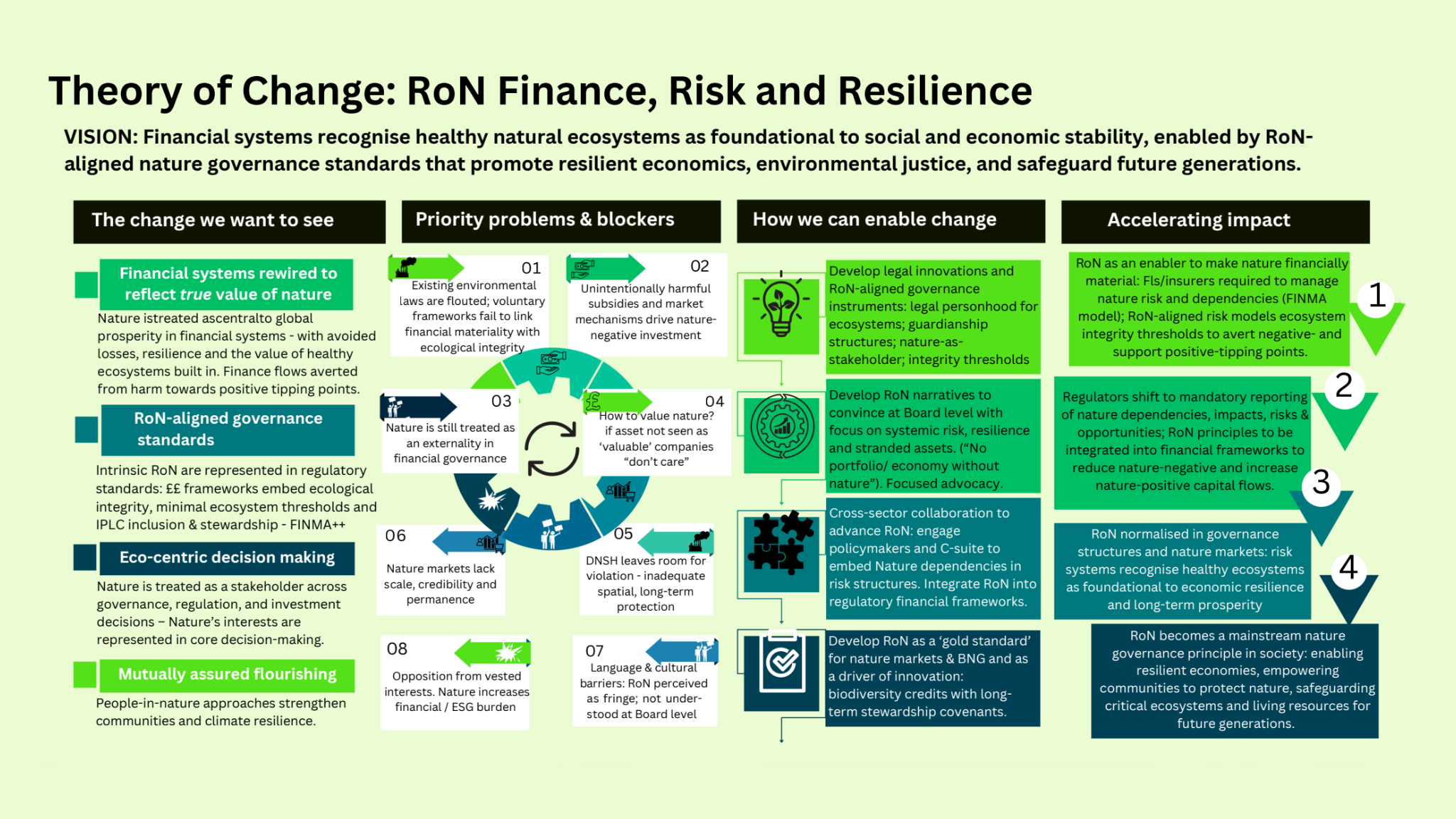
Rights of Nature as a Theory of Change
As we considered what a ‘Theory of Change’ towards a nature-aligned financial system would look like, we came up against the core challenges. Fundamentally, financial institutions are wired to value commodities (dead, extracted resources) but are still clutching at straws when it comes to putting a value on living healthy ecosystems. Three years since the first biodiversity credit was traded, nature markets are still nascent, with funds closing due to undercapitalisation. The gap between nature-positive intention and investment is huge: with finance flowing towards naturenegative investments still dwarfing naturepositive flows.
We considered positive examples where attempts to put a value on living nature have resulted in direct action to mitigate degradation. For example, the insurance group Howden worked with Marriot International to restore coral reefs in The Maldives after quantifying the “avoided losses” of losing the “ecosystem services”, particularly the impact on tourism. While the insurance industry has been an early backer of biodiversity credits, it will no doubt be cautious of nature-related litigation as source of potential legal, financial and operational risk.
Another paradigmatic problem is that nature is still sidelined as an ‘ESG’ issue, or financial externality, instead of being viewed as the foundation of a healthy economy/society. We heard from an impact investor in our group that since the Trump-era “ESG backlash”, investors have begun reframing NbS as investments in “essential infrastructure”, “civilisation technologies” and now “national security”.
We also heard from a nature tech provider that companies fear imperfect action – or are waiting for “more assured” data before investing – which results in paralysis.
Could RoN strengthen financial frameworks?
To inform the discussions, members were invited to take part in a mapping exercise to identify where the Rights of Nature might intersect with (and strengthen) financial frameworks and taxonomies. Just as RoN principles are being used by environmental law groups – including Environmental Law Foundation, Lawyers for Nature, Earth Law Center, UKELA – to strengthen existing laws and advance corporate governance through Nature-as-Stakeholder approaches, we considered how RoN mechanisms could be used almost as a “governance upgrade” for financial decision-making.
Across the Global Biodiversity Framework and the major disclosure ESG frameworks (TNFD/ISSB, GRI, CSRD/ESRS) nature is embedded through impact, risk and dependency assessments, but these reporting systems are rooted in what is financially material and remain harm-thresholdbased. RoN positions natural ecosystems and species as rightsbearing entities (not merely externalities) and introduces guardianship and legal representation models for addressing infractions. For example, the groundbreaking Los Cedros ruling in Ecuador (2021) shifted the burden of proof for ecological harm to the state and developers.
The mapping highlighted gaps in existing taxonomies and showed how RoN principles and approaches (in the absence of a broadly accepted RoN legal framework) could provide a corrective: introducing high integrity sciencebased ecological thresholds and strengthening corporate governance and directors’ duties. It outlined the impacts/implications and opportunities of RoN for different financial stakeholders – for example, tying impacts and outcomes to environmental justice through Indigenous and Local Community-led (IPLC) stewardship.
The group also considered how RoN had potential to bring Biodiversity Net Gain (BNG) along by shifting it from a transactional, compliance exercise toward a governance model centred on longterm, living stewardship and representation for ecosystems and species within landownership structures.
One of the positive outcomes of discussions was that two members went on to advise the TNFD’s Guidance on environmental crime’ on the section ‘Emerging legal concepts’ covering the Rights of Nature, Ecocide and senior management accountability, in the context of financial risk and environmental harm.
What did we learn?
There was broad agreement that RoN could be a powerful enabler: for moving beyond disclosures and divestment towards active stewardship; away from thresholds and damaging permits to long-term ecosystem integrity; and for bringing “the voice of nature” into decision-making. But “getting the language right”, as well as the application of RoN mechanisms (case by case), will be absolutely critical. Corporate leaders are comfortable with good governance concepts but startled by the language of rights, which raises potential for operational conflict and risk. As it grows, the RoN movement is likely to come up against a rising swell of opposition, not only from private vested interests, but general scepticism that this is a “fringe issue”.
But if we recentre the economy within nature, then RoN is far from fringe. And Earth Law is not just for the non-human – it is interwoven with basic human rights such as the right to a healthy environment, access to wild nature, to potable water, and the rights of future generations including other species.
The discussions culminated in an in-person event ‘From Theory to Practice: Advancing the Rights of Nature in Law, Policy and Finance’ that considered our findings alongside those of the Law and Policy group. As the lightening talks from participants ran over into networking time, it was clear we had just scratched the surface. Further analysis and collaboration are needed – either through more focused groups, or a dedicated committee to bring law, policy and finance together for stronger nature governance.
We are at a turning point on nature. Central banks and supervisors are beginning to embed nature into sovereign risk assessments – a powerful lever for change. Naturerelated supplychain shocks are already moving markets – Nestlé’s share price has fallen multiple times this year due to coffee and cocoa supplychain pressures.
Pathways ahead for business leaders
If they aren’t already doing so, regulators and policymakers must start treating nature-related risks both as physical and systemic risk (prudential, credit risk, market risk, underwriting risk, operational risk and interrelated transition risks). Upgrading financial frameworks in line with the 2026-2028 Swiss FINMA Nature Risk Reporting Requirements (that mandates Swiss banks and insurers to move beyond disclosure to actively manage nature-related financial risks and dependencies including biodiversity loss, ecosystem degradation, and climate transition exposures) would be a good start.
Investors should begin embedding nature-risk in funding decisions and stress-testing portfolios: water scarcity and pollution, the collapse of food chains due to drought and soil erosion, and general supply chain fragility represent direct financial exposure. “Your portfolios will be worth precisely zero unless we invest in nature recovery,” is how one investor in our group put it.
Organisations of all sizes need to do the work to get nature onto the balance sheet and get a handle on nature risk. That means nature materiality impact assessment and scenario modelling, analysing supply chain portfolio exposure and reducing impacts and dependencies, adopting “avoided-losses” metrics where relevant. The frameworks and resources for doing this exist: TNFD’s LEAP approach helps organisations identify and assess nature-related issues; the Network for Greening the Financial System maps out how to perform Nature scenario analysis; the IBA this year published a Nature-intelligent toolkit for legal services providers.
Nature-dependent organisations (which, arguably, is most) could invest in nature-based resilience through nature markets, especially where material to their business model (for example, beverages companies investing in water resources management); and start the transition to regenerative business models.
Purpose-led businesses could introduce nature governance via risk committees and Nature-as-Stakeholder models – there are many ways to do this. Each organisation must consider what structures most effectively and authentically represent Nature’s interests. If the avoidance of ecological harm were tied to fiduciary duties, the needle would shift in the right direction. Furthermore, nature-positive principles and nature guardianship could be integrated company culture through training and volunteering schemes. These innovations have substantial transformative potential and don’t require regulatory change.
The business community must get behind a shared narrative and commit to the shared idea that there is “no economy without nature”. That requires multi-stakeholder engagement, advocacy and wider public debate. Recent research from the LSE ‘Facing the Global Biodiversity Crises and Sixth Mass Extinction’, conducted across five countries including the UK, shows people have a strong emotional response to the nature crisis – so it should be an easier sell than net zero.
Ultimately, the RoN Finance, Resilience and Risk group unlocked more questions than we were able to answer – a sign of progress perhaps. What regulatory triggers could be used to ensure nature risk management? How do we define “minimum ecological operating conditions” for the UK economy? Can Rights of Nature approaches and principles be integrated into nature markets metrics and BNG planning protocol to raise standards? And finally, how do we build political will for nature governance before advancing ecosystem breakdown and eventual systemic collapse forces it?
Some of these questions are being addressed in the Nature, Legal and Finance Forum, convened by the Legal Charter 1.5 – a cross-disciplinary collaboration bringing together legal professionals, investors, insurers, policymakers, academics and governance experts to explore the legal, fiduciary, regulatory and practical implications of nature-related impacts, risks and opportunities.
5 GOALS: to move Rights of Nature from a legal concept to a practical framework for financial decision-making, corporate governance, market design and public policy.
Rights of Nature (RoN) is increasingly being explored as a practical response to accelerating biodiversity loss, ecosystem degradation and the growing recognition that existing governance frameworks are failing to halt nature decline. Once viewed primarily as a legal concept, RoN is now gaining attention from policymakers, regulators, investors, businesses and civil society as a catalyst for systemic change. Translating these principles into real-world governance, financial and policy frameworks remains an emerging challenge. The following goals propose a practical agenda for a cross-sector initiative to explore how RoN principles can inform decision-making, accountability and long-term stewardship
GOAL 1.
Financial institutions are mandated to identify and disclose nature-related dependencies, impacts, risks and opportunities (DIROs) in line with TNFD guidance, and to act on these insights through stewardship, investment decision-making and capital allocation to support a nature-positive transition.
GOAL 2.
Nature markets aligned with Rights of Nature principles – explore how RoN can strengthen biodiversity credits, biodiversity net gain and other nature markets by supporting long-term stewardship, ecological integrity, guardianship models and science-based governance arrangements.
GOAL 3.
‘Nature-as-Stakeholder’ mechanisms embedded in corporate governance – advance governance approaches that give greater weight to biodiversity and ecosystem risks, including nature representation within risk and audit processes, Nature-on-the-Board models and other stakeholder governance structures.
GOAL 4.
Policy and financial incentives aligned with the rights of ecological systems – explore how subsidies, incentives, regulatory frameworks and financial policies can better reflect the intrinsic value of nature alongside the human right to a healthy environment, engaging policymakers, regulators and legal experts in the process.
GOAL 5.
Cross-sector coalition established for stronger nature governance – bring together legal, finance, insurance and banking specialists to develop shared narratives, governance tools and policy proposals that position nature governance as risk mitigation, resilience building and long-term value protection.
² Source: UNEP’s State of Finance for Nature report, 2026